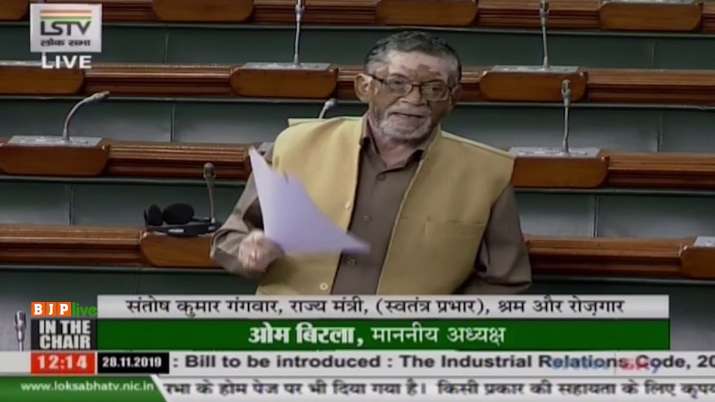
The Minister of State (Independent Charge) for Labour and Employment, Shri Santosh Kumar Gangwar introduced the Industrial Relations Code Bill, 2019 in the Lok Sabha today.
Earlier, opposing the introduction of the bill, RSP KNK Premachandran, Trinamool Congress's Saugata Roy and Congress's Adhir Ranjan Chowdhary, calling the said code anti-employee, demanded the government to send it to the Parliamentary Standing Committee on Labour, said that it has not consulted the states. Sowat Rai said that no labour organization had demanded this code and said Industry organizations wanted, so the government has brought it on its own. Describing it as 'anti-labor', he said that it should be sent to the Standing Committee on Labour. Chaudhary also demanded to send it to the Standing Committee stating it as 'anti-labor'.
Minister of State for Parliamentary Affairs Arjun Ram Meghwal said that the members have not given any single reason to prove that there is no legislative authority to bring the bill to this house. K. Subbarayan and CPI-M's Abdul Majeed Arif and S. Venkatesan also sought permission to speak in opposition to the introduction of the bill, but the Lok Sabha Speaker said that notices had not been given in the past. Members can elaborate during the discussion. Left not allowed to speak, members of the Left walked out of the House. Gangwar said that the government has brought the Industrial Relations Code after long discussion and consultation with labor organizations and all state governments. There is no provision against the rights of workers. He then introduced the 'Industrial Relations Code, 2019' in the House.
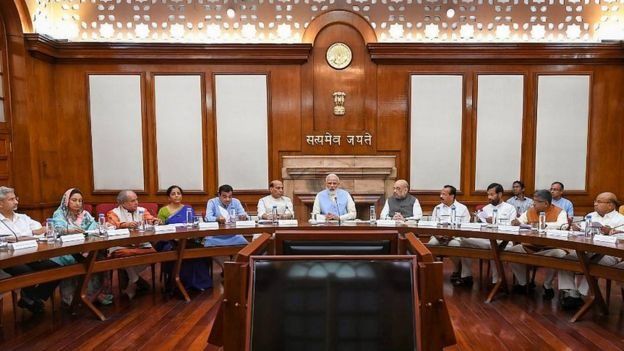
While presenting the bill, Mr. Gangwar said that this code has been prepared after extensive consultation with representatives of trade unions, employee organizations and state governments. The Bill aims to consolidate and amend the laws relating to the service conditions of employment in trade unions, industrial establishments or undertakings and the investigation and settlement of industrial disputes. The draft Industrial Relations Code is governed by these three Central Labour Acts like the Trade Union Act, 1926; The merger, simplification and rationalization of the relevant provisions of the Industrial Employment (Standing Order) Act, 1946 and the Industrial Disputes Act, 1947 have been prepared. The Union Cabinet approved the Code of Industrial Relations, 2019 on 20 November 2019.
Benefits :
A concept has been introduced through the formation of a two-member tribunal (in place of one member), which will jointly adjudicate on some important matters, while the remaining cases will be adjudicated by a single member.
There will be flexibility in the 'exit' provisions (relating to lay-offs, etc.), under which the initial limit required for prior approval of the appropriate government has been kept unchanged at the level of 100 employees.
However, a provision has also been added to it, under which 'such number of employees' can be changed through notification. Reskilling fund, which will be used to lend to workers in a manner that is yet to be determined.
Definition of fixed-term employment. There would be no notice period under it and excluding compensation on lay-offs. Government officials will be empowered to adjudicate on disputes related to penalties as fines, reducing the tribunal's workload.