
For weeks after the assembly election results, there was a tussle between BJP, Congress, Shiv Sena and NCP for power in Maharashtra. The BJP, which had emerged as the single largest party, could not stake claim to form the government due to unease over power-sharing with its former ally Shiv Sena. Since all parties failed to prove majority, President's rule was imposed on November 12, 2019. On the night of 22 November, there were reports that a coalition of Shiv Sena, NCP and Congress would soon form the government. However, the next day everyone got a shock when the BJP formed the government, claiming the support of NCP MLAs. President's rule was repealed under Rule 12 of the Government of India (Transaction of Business) 1961 at 5:47 am, just hours before the oath ceremony. The provision that was used by the Prime Minister to repeal President's rule is Rule 12 of the Government of India (Transaction of Business) 1961. This provision states: "Rule 12 of the Government of India (Transaction of Business) 1961 gives the Prime Minister the right to allow or ignore deviations from the rules to the extent necessary to settle a situation of excessive urgency or unexpected contingency in a particular case. Even in such situations, the process of trial and inter-ministerial consultation has to be followed. All the cases are mandatory under Rule 12 Must be forwarded through the Cabinet Secretary and sent directly to the Prime Minister in any case. The following guidelines are required to be followed in cases necessary for Rule 12 to be implemented:
A) Proposals only Administrative Ministry / To be extended by the Department, which will be related to the subject of Government of India (Allocation of Business) Rules, 1961.
B) A detailed justification in the proposals It must clearly state the urgency and exceptional circumstances involved in the case, which need to be processed under Rule 12, as well as a statement explaining the reasons why the proposal received the approval of the competent authority in time. Why can't it be processed.
C) The Secretary of the Department / Ministry shall ensure that all requirements including inter-ministerial consultation are met before submission of proposals for approval under this rule. This fact has to be mentioned in the proposal submitted for approval under Rule 12
D) The concerned Ministries / Departments in all matters, the Minister in-charge, Finance Minister in matters related to the outflow of funds, and the Minister concerned, whose work involves the subject, approved the proposal through Cabinet Secretary.
The origin of the provision is in Article 77 of the Indian Constitution titled "Conduct of the work of the Government of India". This shows that under this article work has been set by the Government of India in relation to its businesses. Clause 3 of the said article states that "The President shall make rules for the more convenient transaction of business of the Government of India and the allocation among the ministers of the said business". The Government of India (Transaction of Business) Rules 1961 has been made under Article 77 (3). The power to make rules of business can be ascertained under the said rule in Article 53, which states that the executive power of the Union shall be exercised directly by the President or by his subordinate officers in accordance with the Constitution and Article 74 (1), Under which they are required to discharge their functions with the help and advice of the Council of Ministers. This means that the decisions of the Government of India are not always taken personally by the President. Decisions can be taken by the concerned minister or authorized officer under the rules of business decided by the President under Article 77 (3). It has been said in many cases that if all decisions are taken by the President or even by the Ministers, then the functioning of the government will stop.
Article 77 (3) of the Constitution makes two provisions for better administration: 1. Empower the President to implement the rules of transactions for the smooth conduct of government business; 2) The rules made under provision (1) of allocation of the said business among ministers are the rules of business relating to administration. Authorized officers under these rules are able to take decisions on behalf of the ministers concerned. The minister has control of the overall business undertaken by the department, but in practice most decisions are taken by authorized officials. The work is approved through the signature of the minister. A full reading of the rules in the draft rules giving the Prime Minister special powers will make it clear that the rules are mostly related to the operation of ministries. It prescribes rules for efficient functioning within the Ministry for better administration and redress of issues. It is also involved in matters of the second schedule which require the approval of the Cabinet, e.g., issues of ordinances, cases where differences of opinion arise between two or more, desired decisions of the Cabinet, by the Cabinet in the past.
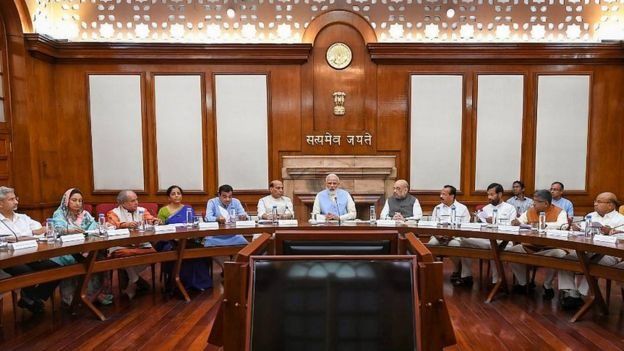
On one of these rules, Rule 12 of the TOB states: Rule 12 states: "Deviations from the rules — the Prime Minister in any case or classes of cases, the Prime Minister, to the extent necessary, to allow or ignore deviations from the rules. Can give orders. The sentence "to the extent necessary" is the discretion of the Prime Minister. These are the conditions of excessive urgency or unexpected contingency in a particular case to the Prime Minister. Gives the right to allow or ignore deviations from the rules to the extent necessary for the disposal of the Act. In the case of Maharashtra, the Governor shall act in accordance with the advice of the Council of Ministers under Article 163 (2) in the absence of any Government. Therefore, the Governor's report According to, President's rule was implemented in Maharashtra. The proposal was to be sent by the Union Cabinet to repeal President's rule in Maharashtra. However, the Central Government by passed the requirement of a Cabinet meeting to be held before the President's rule was withdrawn. Exercised special power under Rule 12 of the TOB, 1961.
On one of these rules, Rule 12 of the TOB states: Rule 12 states: "Deviations from the rules — the Prime Minister in any case or classes of cases, the Prime Minister, to the extent necessary, to allow or ignore deviations from the rules. Can give orders. The sentence "to the extent necessary" is the discretion of the Prime Minister. These are the conditions of excessive urgency or unexpected contingency in a particular case to the Prime Minister. Gives the right to allow or ignore deviations from the rules to the extent necessary for the disposal of the Act. In the case of Maharashtra, the Governor shall act in accordance with the advice of the Council of Ministers under Article 163 (2) in the absence of any Government. Therefore, the Governor's report According to, President's rule was implemented in Maharashtra. The proposal was to be sent by the Union Cabinet to repeal President's rule in Maharashtra. However, the Central Government by passed the requirement of a Cabinet meeting to be held before the President's rule was withdrawn. Exercised special power under Rule 12 of the TOB, 1961.



No comments:
Post a Comment