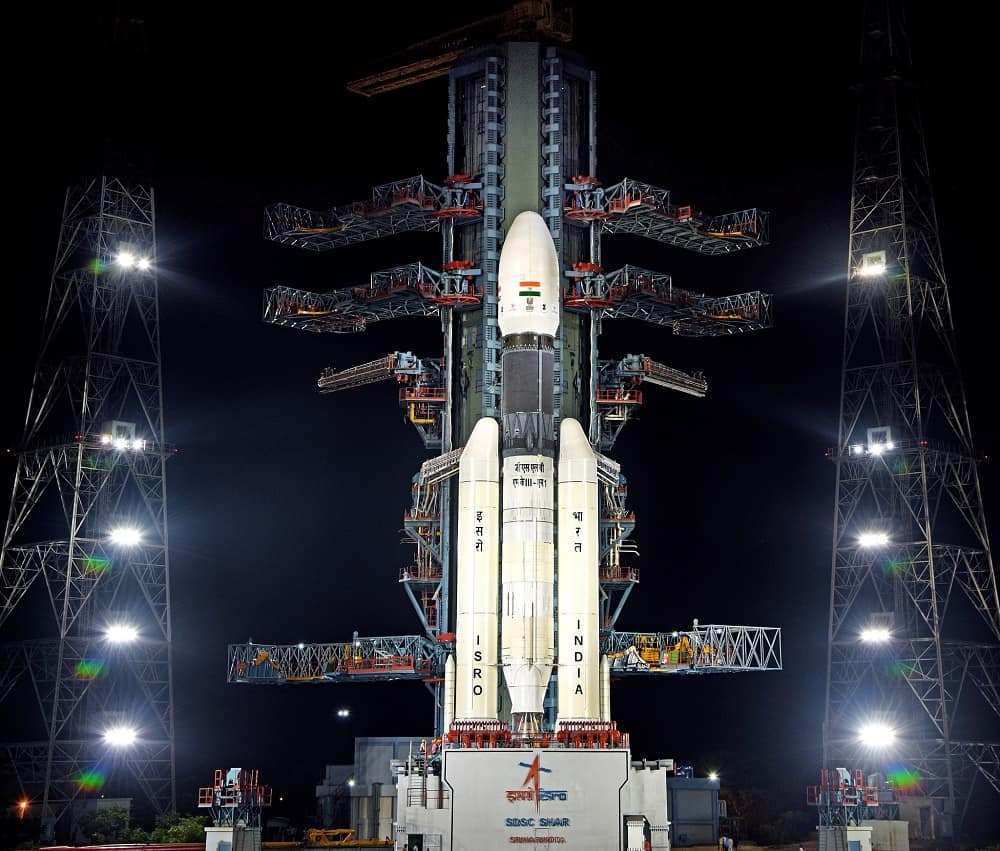
NASA has joined ISRO in attempting to gather response from Chandrayaan 2 lander VIKRAM that lies motionless on the moon. The connection between the orbiter and VIKRAM lander snapped on the early hours of September 7 when ISRO has planned its soft landing on the Lunar surface. For over 4 days now ISRO has been trying to establish communications with moon lander VIKRAM. Even all methods to establish communications has proven unsuccessful. ISRO feels there is one way to connect lander through "X BAND". X BAND is band of frequencies in microwave radio region of electromagnetic spectrum. It is used for radar, satellite communications, wireless computer networks. In space communications X BAND is allocated for deep space telecommunications. Following this development NASA has sent HELLO messages to the Indian lander on moon. Through its deep space network stations, NASA Jet Propulsion Laboratory beaned a radio frequency to VIKRAM in order to establish contact with lander.
Communications to Chandrayaan 2:
ISRO has also taken help of NASA DSN to track Chandrayaan 2 integrated modules while it was on its way to moon from Earth's electrical orbit. The orbiter is designed to communicate with ISRO's and NASA's DSN antennae. The lander VIKRAM was also designed to communicate directly with Earth and it is capable with communicating with the orbiter which in turn can relay its messages to Earth. The lander can also relay images taken by Rover to ISRO's and NASA's DSN. However, during the final minutes of Vikram's dissent, communications froze about 400 meters before its land on Lunar surface. The hope of reviving lander Vikram is till the day when 14 Earth day will get over on 20th to 21st September. After which the lander will no longer remain exposed to the Sun's rays and hence there would be no hope to energize the solar panel.
Chandrayaan 2, The Journey: On September 2, Vikram successfully separated from Chandrayaan 2 orbiter following which two de-orbiting manoeuvres were performed to bring it closer to the moon. On September 7, it successfully completed Rough Braking phase but lost communications with the ground stations during Fine Braking Phase.
What is Deep Space Network or DSN ?
In simple terms Deep Space Network or DSN is communication hub for deep space explorations. It is Giant radio antennas support inter planetary space craft mission. It also provides Radar and Radio astronomy observations that improve understanding of solar system and larger universe. Deep Space Network is powerful system to command, track and monitor the health and safety of space craft. The antennas of DSN has indispensable link to planetary beyond earth. They provide crucial connections for commanding space craft receive their scientific information on earth. The DSN acquires, processes, decodes and distributes telemetry data that is made up of crucial science and engineering information transmitted to earth via radio signals from space craft. Space mission use DSN command system to control activities of space craft. Commands are sent to the robotic probes as coded computer files that the craft execute as series of action. DSN tracking system provides two-way between Earth and Space craft making measurements that allow flight controller to determine the position and velocity of space craft. DSN antennas are used by space mission to perform experiments using the radio signals sent between a space craft and earth. NASA's deep space network is the world's largest and most sensitive scientific telecommunication system which provide round-the-clock coverage of solar system.
History of Deep Space Network :
The deep space network was conceived by NASA as worldwide telescope array that could communicate with space craft throughout solar system. The Forerunner of deep space network was established in January 1958. The Jet Propulsion Laboratory was under contract with US Army deployed portable radio tracking stations in Nigeria, Singapore and California. When the US Army successfully launched its first satellite Explorer 1, these stations received telemetry and helped mission controller plot the space craft's orbit. In October 1958, NASA was officially established to consolidate the separately developing space exploration programmes of the Army, Navy and Air Force into one civilian organisation. On December 3, Jet Propulsion Laboratory or JPL was transferred from Army to NASA and given responsibility of design and execution of Lunar and Planetary exploration programmes using robotic space craft. Shortly afterwards, NASA established Deep Space Network as a separately operated communications facility that could accommodate all deep space missions. The DSN was given responsibility for its own research, development and operations. 1963 was DSN's first year of operation during which it communicated with three space craft. As of 2013, the DSN communicated with 33 space craft across the solar system.
Indian Deep Space Network :
More than a decade ago, India's Chandrayaan 1 space craft successfully conducted the country's first lunar mission. On July 22, 2019 India launched Chandrayaan 2 to explore the moon's south pole region. Unlike most other moon mission Chandrayaan 2 travels nearly 30 days before ejecting itself to the moon's orbit. However, ISRO lost communication with Vikram lander just some distance away from the lunar space. But ISRO is trying its level best to establish communications with Vikram lander. Many Government entities located in Bangalore are monitoring the mission from the ground. For example, antennas are the Indian Deep Space Network or IDSN was set up to receive Chandrayaan 2 data and information. ISRO is now trying to communicate lander through IDSN. IDSN is network of large antennas and communications facilities to support the inter planetary space craft mission of India. It consists of 3 antennas, 11 meter antennae, 18 meter antennae and 32 meter antennae. Its hub is located at a village near Bangalore and Karnataka. Indian Deep Space Network was inaugurated on 17th October 2008. The first 18 meter antennae of IDSN was built to track India's first Lunar mission Chandrayaan 1 and the unmanned lunar launched on 22 October 2008. The 32 meter antennae of IDSN is tracking ongoing Mars orbiter also known as Mangalyaan. The IDSN facility also houses the ISRO's navigation centre. The centre became active on 11th June 2013 at the time of launch of IRNSS 1A, the first of the India's Regional Navigation Satellite System Series of Satellite. It will be used to coordinate across the 21 ground stations in India.




No comments:
Post a Comment